The Lighthouse in Winter
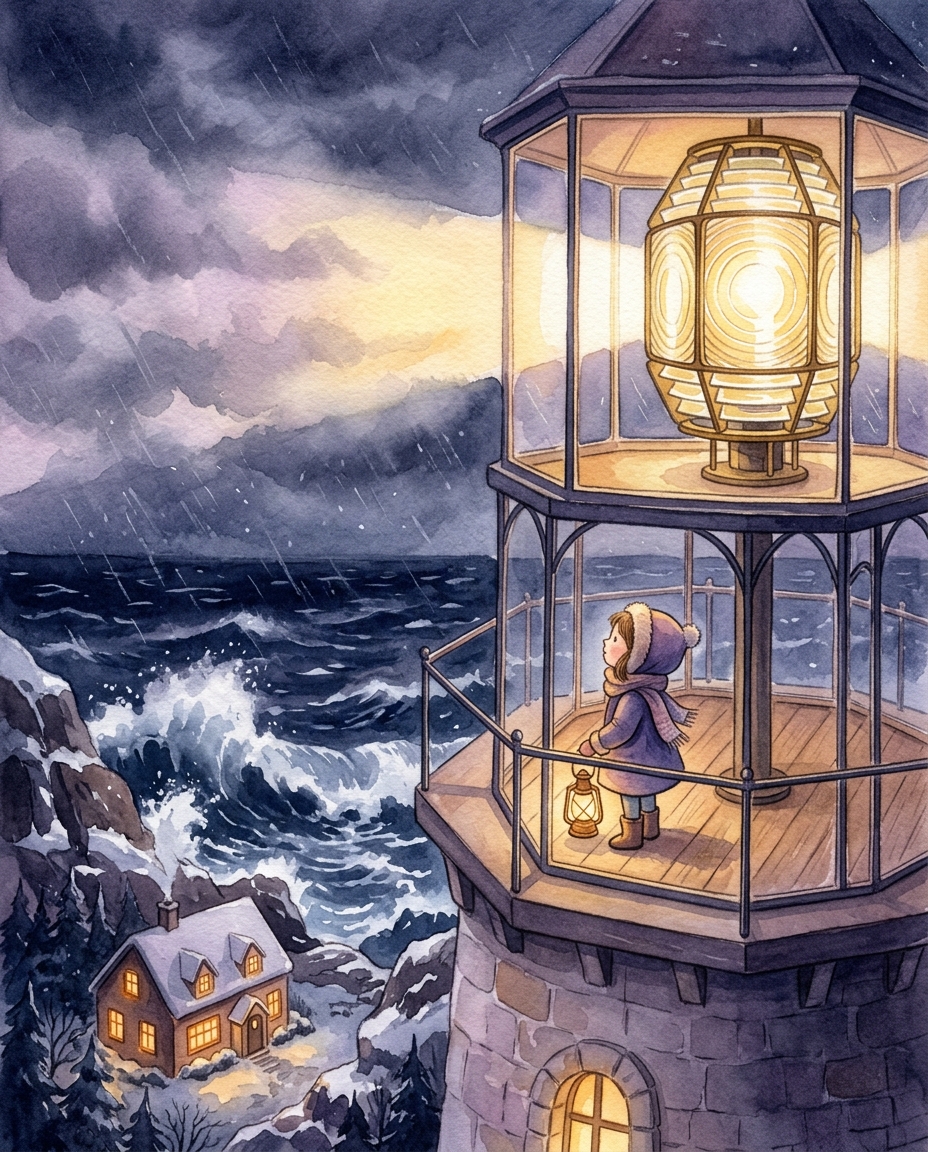
Her father had been coughing since Wednesday, the serious kind of cough that he tried to hide by turning away and pressing his sleeve to his mouth, but Nessa had learned to read these things.
By Friday evening, when she brought him his supper, he was in bed.
"The light," he said, the moment she came in.
"I'll do it," she said.
He looked at her. He had been the keeper of Dunhallow lighthouse for twenty-three years. Nessa had lived her whole life in the keeper's cottage attached to its base, had climbed the tower stairs so many times she could count them in her sleep — seventy-two from the ground floor to the lantern room — had watched him tend the mechanism a hundred evenings running. She knew the sequence. She had never done it alone.
"The storm is going to come in hard tonight," he said.
"I know."
He said nothing for a moment. "The main gear wants to be wound every two hours. If the wind exceeds a certain speed, the vane on the south side will flag — you'll see it from the lantern room window. If it flags, close the outer louvres, all four of them. The mechanism will compensate."
"I know all of this."
He looked at her again, and this time the look was different. "Yes," he said. "You do." He lay back. "Call me if you need to."
"I will," said Nessa. They both understood she would not.
She climbed the seventy-two stairs with the spare oil can in one hand, counted them as she always had, and arrived in the lantern room as the last light left the sky.
The storm arrived at midnight.
She had expected it to feel different from this height — more precarious, more exposed — but the glass was thick and the mechanism was steady and the beam swept the black sea in its familiar long arc, once every nine seconds, and she found that the rhythm of it was a kind of company.
She wound the main gear at midnight and at two and at four, working the handle the way she'd watched her father work it: not too fast, in long firm rotations, until the counterweight was fully raised. She checked the south vane twice — it held both times, and she was almost disappointed not to have the louvres to close.
At three o'clock the wind was very loud. The windows shook. Something on the exterior walkway broke loose and clattered. The sea below was a churning dark mess she could only occasionally see in the sweep of the beam.
She stayed in the lantern room and did what was necessary, and it was enough.
At six in the morning, the storm began to ease. The sky lightened from black to charcoal to a pale, exhausted grey. The beam was still sweeping.
She went downstairs, filled the kettle, and made tea. She took a cup up to her father.
He was sitting up. He looked better, or better enough.
"How was it?" he asked.
Nessa thought about the right way to answer. She thought about the three o'clock wind and the counterweight and the south vane and the long arc of the beam across the black water, which had gone on steady and reliable all night regardless of the storm.
"Manageable," she said.
Her father wrapped both hands around the tea cup and looked at her with an expression she had seen him give the sea sometimes — a kind of respect for something that had proved itself in hard conditions.
"Yes," he said. "I thought it would be."
Hearth Yarns
Hear it narrated — with watercolour art
Get the app to hear this story read aloud, or generate your own in a voice you record.