The Last Lantern Keeper
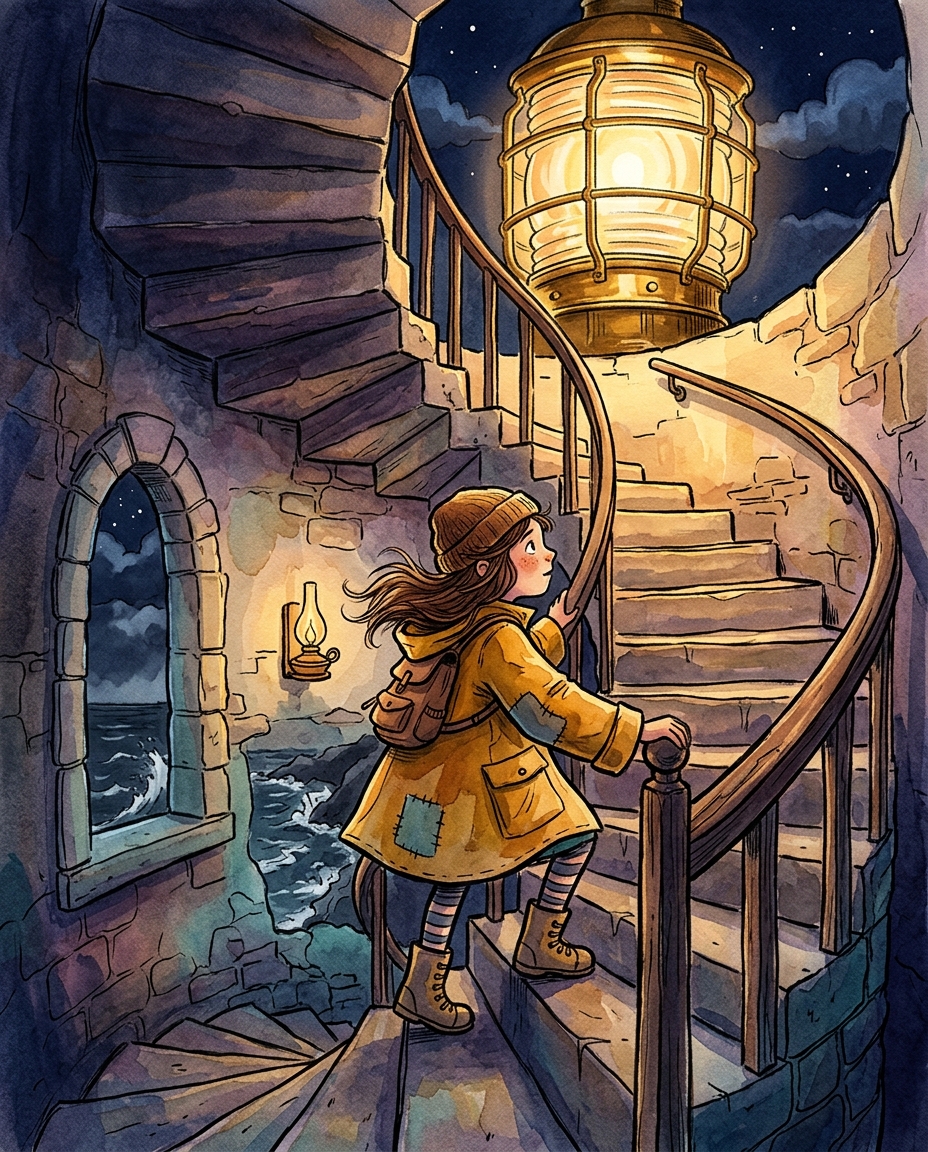
The village of Crestholm sat on a black rock coast where the sea came in sideways and the wind had opinions about everything.
There had been a lighthouse there for as long as anyone could remember, and for the past twelve years, it had been kept by a man named Edmund Farrell and his daughter, Elara.
Elara was ten years old. She had spent her whole life in the lighthouse keeper's cottage at the foot of the tower, and she could do almost everything her father could do. She could trim the lantern wick and fill the oil reservoir. She could read the weather glass and the logbook. She could spot the difference between a regular swell and the long rolling waves that meant a storm was coming in from the north.
She had just never done any of it alone.
On the third night of December, the storm came in from the north.
Elara woke at midnight to the sound of rain hammering the roof like gravel. She could hear the sea — a deep, persistent roar that she felt in her chest more than heard with her ears. She lay still for a moment, listening.
Then she heard something else. Her father's cough, low and rough, coming from his room down the hall.
She got up and knocked on his door. He was pale and feverish, bundled under every blanket in the house, and when she suggested calling for the doctor in the morning he only nodded and did not argue. That told her more than anything how ill he was.
"The lantern," he said.
"I know," said Elara.
"You'll need to—"
"I know how," she said.
She dressed quickly, put on her oilskin coat, and stepped out into the storm.
The wind hit her immediately, pressing her back against the door. Rain stung her face. The path to the lighthouse tower was thirty steps — she had walked it ten thousand times — but in the dark with the wind trying to push her off it, she counted every step out loud until she reached the heavy iron door.
Inside, the spiral staircase was quiet and cold. She climbed with her hand on the rail, breathing steadily.
At the top, the lantern room was dark. Below her, through the glass, she could see nothing but black sea and the occasional white bloom of a wave. Somewhere out there, she knew, there could be a boat.
She opened the oil reservoir, refilled it from the can, checked the wick carefully — not too long, not too short, the way her father had shown her — and struck the match.
The flame caught. Grew. The great lens began to turn.
Light swept out across the water — one long revolution every four seconds, the way it always had, the way it was supposed to.
Elara stood in the lantern room and watched it for a long time.
She stayed until the storm began to ease, checking the flame every hour, logging the weather conditions in her father's logbook in her own handwriting. At four in the morning, she wrote: *Wind NNW, force 7, heavy rain, visibility poor. Lantern burning well. All well.*
She was back in bed before dawn.
In the morning, her father was a little better. He sat up and asked her how it had gone, and she told him — the oil, the wick, the wind, the log. He listened without interrupting.
"Was it frightening?" he asked.
Elara thought about it honestly. "The walk over was," she said. "And the moment before I struck the match." She paused. "But once it was lit, no."
Her father was quiet for a moment.
"I've been meaning to ask you something," he said. "About next year. When you're eleven. Whether you'd like to share the logbook properly. Not just helping — actually keeping it yourself."
Elara looked at him. "You mean be the keeper?"
"I mean be my equal in it," he said. "I should have asked you sooner."
Elara thought about the lantern room, the dark water, the match, and the light going out across the sea to wherever it needed to go.
"Yes," she said. "I'd like that very much."
Hearth Yarns
Hear it narrated — with watercolour art
Get the app to hear this story read aloud, or generate your own in a voice you record.