The Archive of Unfinished Stories
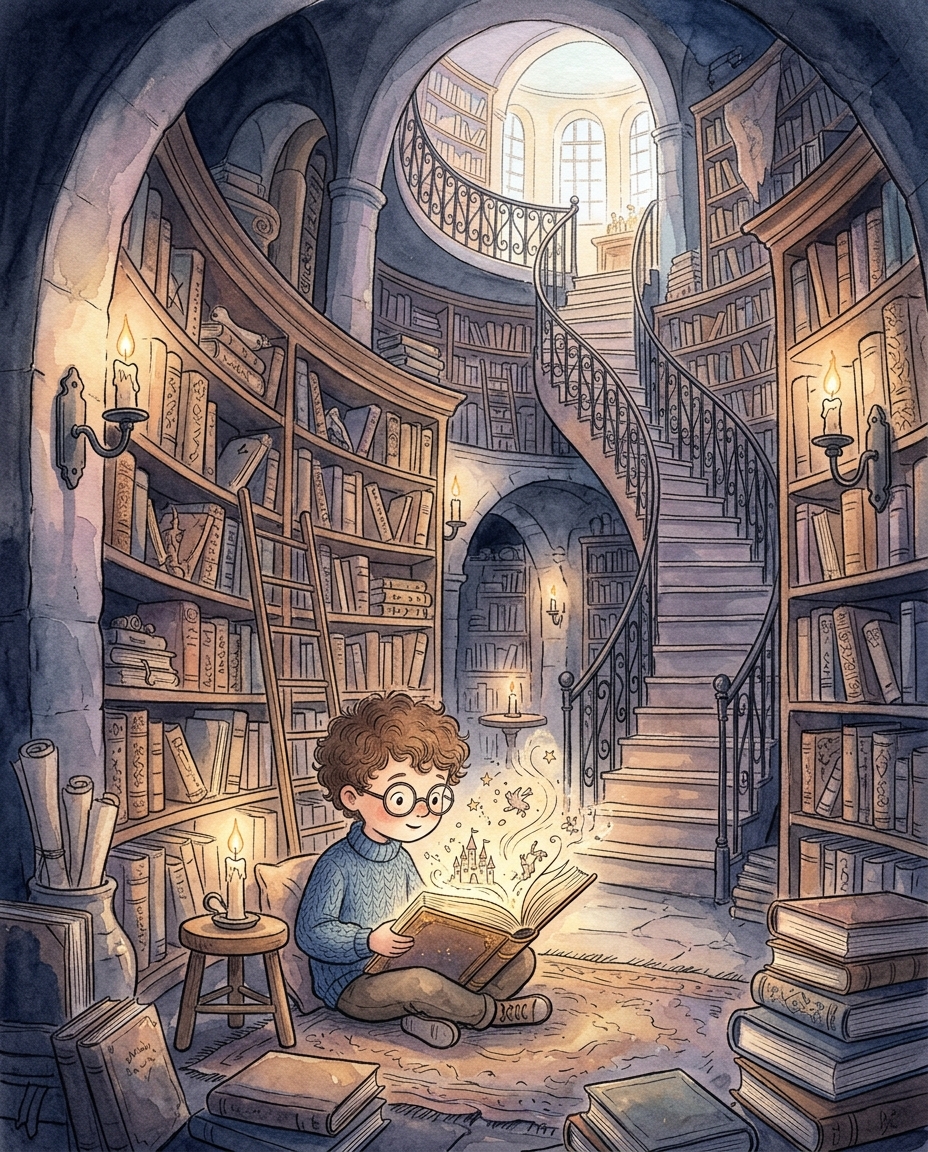
CHAPTER ONE: The Living Shelf
The Archive of Forgotten Stories occupied the lowest level of the Great Library, and most people who worked in the library above it had never been down.
The stories in the Archive were not lost — lost implied an accident. They were set down. Placed deliberately on the shelves of the lower level by their authors, who had run out of whatever it was that stories require: time, will, the right ending, any ending at all. They were catalogued and filed and left in the dark, which was not entirely different from where stories live when no one is reading them.
Theo had been cataloguing them for a year.
He was twelve. He had been given the work as a starting position — the junior-most possible task — and he had done it carefully and without complaint, because he found the work interesting. Every story down here had been started by someone who had cared enough to begin, and abandoned by someone who had run into something they couldn't get past. He kept notes on what kind of something. He was building a private theory.
It was in the fourth month that he found the living shelf.
He had noticed it because the air near the back-left corner of the archive was different — not warmer, exactly, but more present, the way air feels when there is something breathing in it. He had come back to it three times before he acknowledged what he was noticing.
The stories on this shelf were not the same as the others.
When he opened one — a half-finished tale about a girl who crossed a frozen sea — the page moved. Not a draft from the door. The words themselves. The ink was not dried and fixed but moving very slowly, the way water moves in a still pond when something small has disturbed it.
He put the book back very carefully and stood still for a long time.
Then he took it out again and read what was there.
CHAPTER TWO: The Girl on the Ice
The story was called The Girl and the Frozen Sea, and it began in the middle of a scene: a girl named Alys standing on the ice in the dark, looking north at the lights that moved across the sky in ribbons of green and pale violet.
The story was six pages. It stopped mid-sentence, the way stories do when the author put down their pen at the wrong moment and never came back. The sentence ended: —and Alys saw, through the ice, something moving—
That was where it stopped. The line below it was blank, and the page below that, and then the back cover.
But the ink on the page with Alys moved. And when Theo looked closely, he could see her — not clearly, not as a picture, but as a sense of presence in the words, the way a shape in fog makes itself known not by detail but by the fact of being there.
She had been standing on the ice since whenever this book was shelved.
Theo looked at the blank pages.
He was not the author. He had thought, for a week, about whether this mattered. He had read everything in the Archive about unfinished stories and found very little guidance. He had asked the senior archivist, carefully and indirectly, what happened to the characters in stories that were never completed, and the senior archivist had given him a long answer about metaphor and literary theory that did not address the question.
He came back the next evening with a pen.
He did not add to the story. That was not his to do. But on the blank page after the last line, he wrote — not in the story's voice, but in his own:
*I see you standing on the ice. I don't know what was meant to happen next, but the lights are still moving above you, and the thing beneath the ice is still there, and you are still holding your breath. I can't finish this for you. But I want you to know that someone came, and saw, and is very sorry it was left this way.*
He was not sure if this helped.
The ink on Alys's page moved differently for the rest of that evening — not calmer, but perhaps more settled. He wasn't certain.
He kept coming back.
CHAPTER THREE: The Work of the Archive
Over the following weeks, Theo worked his way along the living shelf.
There were nine books on it. He read each one carefully before he wrote anything in the blank pages. He wrote to the characters the way he would write to someone he had read about and wanted to acknowledge — briefly, honestly, without making promises he couldn't keep.
To the knight who had spent thirty pages searching for a lost city and been left without finding it, Theo wrote that the searching had been extraordinary and that the city, wherever it was, had deserved to be found by someone who had looked so hard.
To the two sisters who had reached the edge of the enchanted wood and then been left there, mid-argument, mid-step, he wrote that they were clearly going to be all right, and that being mid-argument was at least better than being mid-silence, and that the wood had looked interesting from the outside.
To Alys, the last time he visited before winter, he wrote: *I have thought about the thing beneath the ice. I think it was something good. I think you would have been glad, in the end. I hope that helps.*
He didn't know if any of it helped.
He catalogued the living shelf separately in his notes, marked with a notation he invented himself: *unfinished, possibly still present*. He added a recommendation — the first recommendation he had ever put in an archival report — that these nine books be given a particular kind of attention: not completion, which was not his to offer, but witness. That someone should come and read them every year. That the characters inside should know they were not entirely forgotten.
The senior archivist read the report and called Theo in.
He looked at the young apprentice across the wide desk for a long moment.
"You understand," he said, "that this is a very unusual archival recommendation."
"Yes," said Theo.
"It presupposes something that is — by conventional understanding — not archivally verifiable."
"Yes," said Theo. "I know."
The senior archivist looked at the report for another moment. "I will consider it," he said, which in the language of the Great Library meant: I believe you, but I need to think about what to do with that.
Theo went back downstairs.
It was evening, and the Archive was quiet, and the air near the back-left corner was as present as it always was. He walked to the living shelf and put his hand near the spines of the nine books and stood there for a moment.
He didn't read anything tonight. He just stayed for a while, so that something could be known.
Then he went upstairs, and locked the door carefully, and went home through streets that were cold and bright with the first winter stars, feeling the particular weight of having done something that mattered and not knowing, and probably never knowing, if it was enough.
Hearth Yarns
Hear it narrated — with watercolour art
Get the app to hear this story read aloud, or generate your own in a voice you record.