The Boy Who Wouldn't Play
Callum had been playing the fiddle since he was six years old, and he was now ten, and in those four years he had performed in front of other people exactly once — at a family gathering when he was seven, when he hadn't known there would be an audience, and he had played one tune and then put the fiddle in its case and left the room and not come out for an hour.
He was not afraid of the fiddle. He played it every day, alone in his room, and sometimes in the barn when the weather was wrong for outside, and occasionally in the far corner of the back field where the sound dissolved into the distance before it reached anyone. He played well. He knew this in the plain, factual way that you know things that are simply true.
But the moment he knew someone was listening, something closed up in him like a hand making a fist, and the music stopped.
The Winter Gathering was held in the village hall every December. Everyone came. There was food and dancing and singing and, traditionally, a short concert by anyone who wanted to play. His mother and father and his teacher had all, separately and over the course of three years, suggested that Callum might want to take part.
He had said no three times.
This year he said no again, and then surprised himself by going to the hall the evening before the Gathering — not to play, but to be in the space without anyone in it.
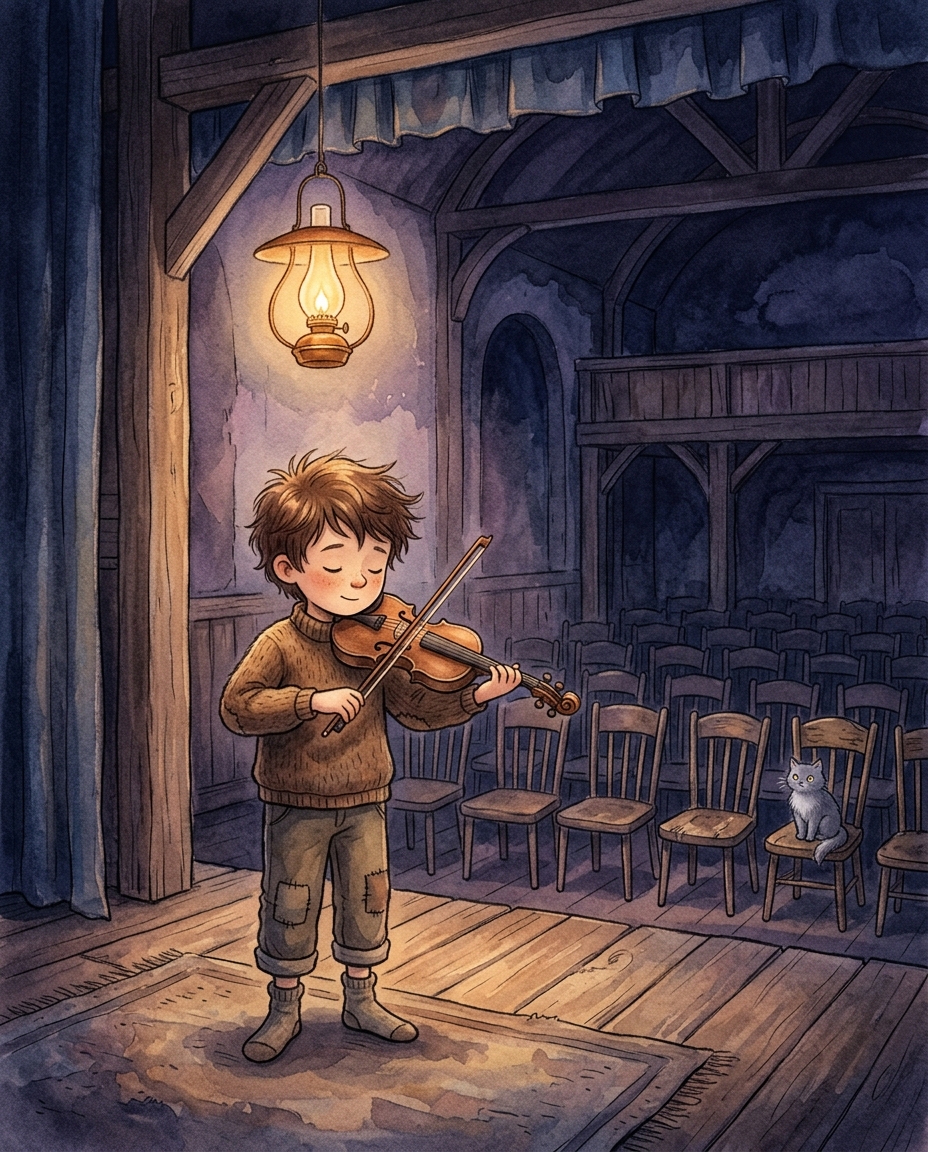
The hall was empty and dark except for a lamp on the stage, which someone had left on by accident. The chairs were stacked. The stage was bare except for a music stand and the lamp. The whole place smelled of old wood and floor wax and something that was the particular smell of a place that held a lot of winter evenings.
Callum sat in the front row for a while.
Then he went up on the stage and stood on it, just to see what it felt like.
Then he took the fiddle from the case he'd brought without quite deciding to, and he rosined the bow, and he started to play.
He played the tune he had been working on for three months — a long, complicated piece he had written himself, which no one had ever heard. He played it for the empty chairs and the lamp and the old wooden walls, and because there was no one to hear him, the fist in his chest never closed.
He was halfway through the second movement when he realised he was not alone.
In the back row, a small grey cat sat perfectly still with her paws folded under her, watching him. She had come in through a gap somewhere. She did not move when he noticed her. She simply blinked once, slowly, in the manner of a cat who is comfortable and intends to stay.
Callum looked at her for a moment.
He played on.
He played to the end of the piece, and the cat listened with the absolute, unself-conscious attention that cats sometimes give to things, and when he finished and lowered the bow, the hall was quiet in the good way — the way a space goes quiet when something has just happened in it.
The cat stood, stretched, and walked out the way she had come.
Callum sat on the edge of the stage for a long time.
The next evening, at the Winter Gathering, he put his name on the concert list. When his turn came, he stood at the music stand in front of a hall full of neighbours and he looked for one moment at the back row — just briefly, just to check.
The cat was there.
He played.
Hearth Yarns
Hear it narrated — with watercolour art
Get the app to hear this story read aloud, or generate your own in a voice you record.