The Mirror Signal
It started by accident.
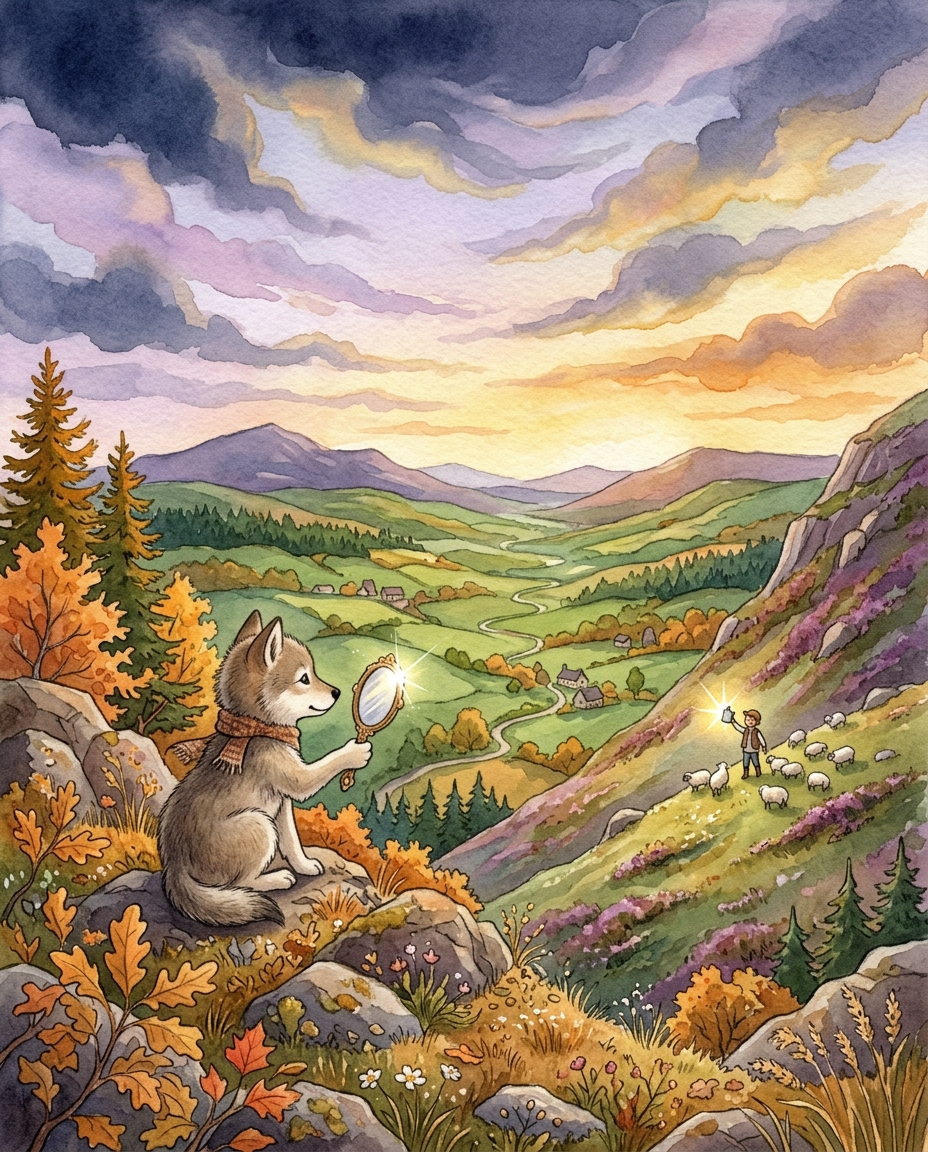
Dara had found a piece of broken mirror in the ruins of an old shepherd's shelter near the top of the ridge. She had been turning it in her paw, watching the way it threw a moving bar of light across the rock face, when she noticed, far across the valley on the opposite hillside, the small figure of a boy stop and shade his eyes and look directly at her.
She moved the mirror. The bar of light moved.
The boy sat down on a rock and watched.
Dara moved the light back and forth, faster and slower. The boy reached into his coat and pulled out something flat and shiny — a tin flask — and held it up so it caught the sun, sending his own moving bar of light across to her side of the valley.
They stayed at it for the better part of an afternoon, sending flashes back and forth without any particular meaning, until the sun moved behind the ridge and the light died.
She came back the next day. So did he.
It took three weeks to develop anything like a language. Short-short-long for yes. Long-short-short for no. Three short for I see you. Three long for wait. It was clumsy and limited and the most interesting thing Dara had done in months. She learned the boy's name by a slow exchange of tapped shapes for letters — though this took two full sessions and considerable frustration on both sides.
Idris was twelve. He shepherded his family's flock on the eastern slope. He walked a lot and read when he had time and wanted to be a cartographer, which he had spelled out letter by letter across the valley.
Dara told him she wanted to know where every path in the valley led, which she had also spelled out across the valley. He had signalled back: me too.
By October they had a fair vocabulary between them. Not enough for everything, but enough for: I am here, all is well, look to the north, careful there, and several other things that had proved surprisingly useful.
The storm came in the last week of October, fast and low and very serious.
Dara watched from the ridge as the flock on the eastern slope scattered in the wind — she could see the white shapes spreading and disappearing into the scrub, and she could see Idris at the centre of it, turning in circles, not knowing which way to go.
She raised her mirror.
Three short: I see you.
Long-long-short, the signal they had worked out for: follow me.
She didn't think about the oddness of it — a wolf, and a shepherd's flock. She moved along the top of the ridge to where she knew the valley narrowed and the natural contour of the land would funnel the sheep toward the old stone shelter in the lower fold, the one she knew from years of crossing it, the one Idris had probably never been to.
She kept flashing. Long-long-short. She moved slowly so the flash could track her direction.
The sheep, finding a narrow way out of the wind, followed the shape of the land — as sheep do — and Idris, following Dara's signals, followed his flock.
By the time the rain came in properly, all sixty-four sheep were in the low fold, sheltered, and Idris was sitting in the door of the old stone shelter with his knees pulled up and the flask in his hand.
He looked across the storm-dark valley and flashed three short.
I see you.
Dara flashed back three short.
I see you.
She turned and trotted along the ridge toward home, the rain coming sideways now, the valley below invisible in grey. She was soaked through and she had an hour's walk ahead of her and she thought, with some satisfaction, that she understood the valley considerably better than she had a month ago.
She had not yet met Idris in person. The valley between them was wide.
But she thought that might change in spring, when the paths were good again.
Hearth Yarns
Hear it narrated — with watercolour art
Get the app to hear this story read aloud, or generate your own in a voice you record.