The Mapmaker's Daughter
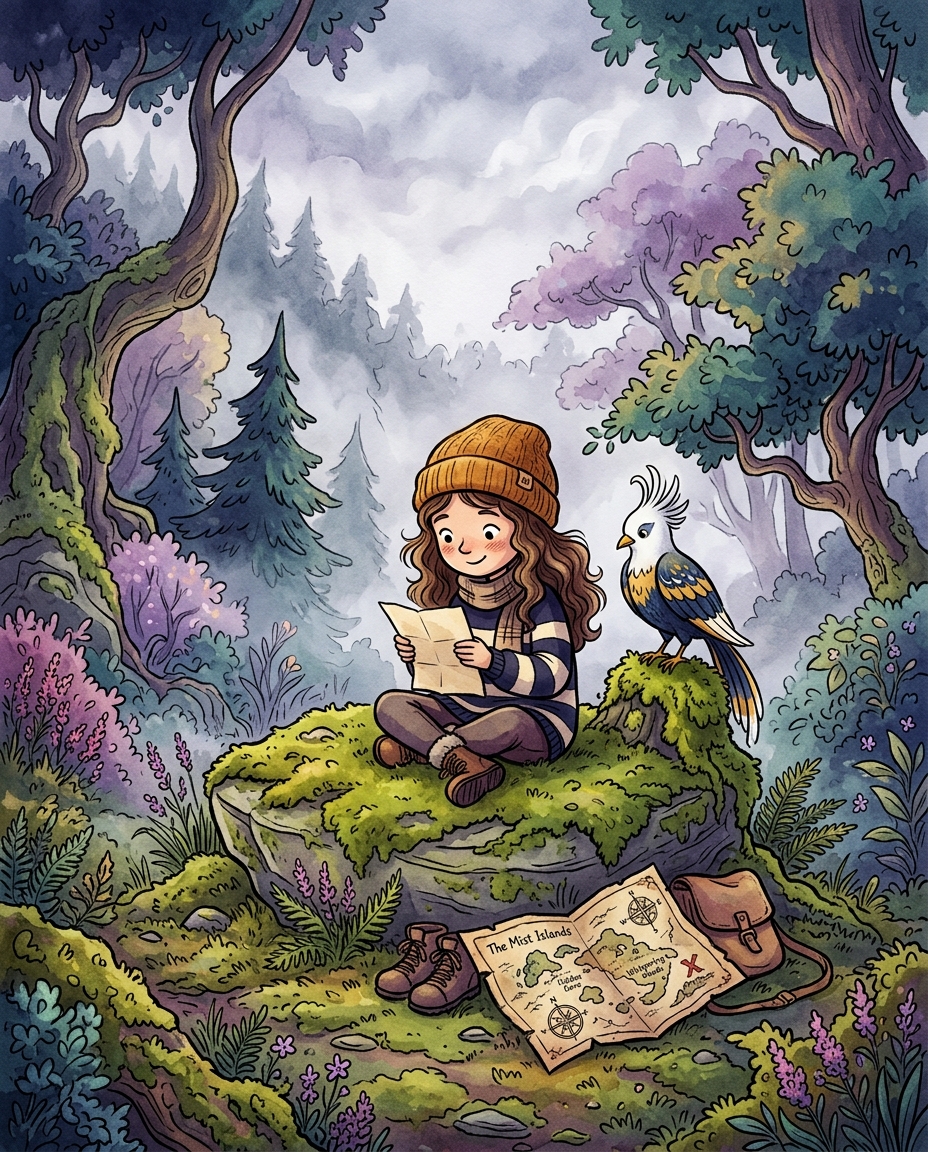
CHAPTER ONE: The Unfinished Map
Wren Calloway was eleven when she found the map.
She had been looking for a pencil in the old chest in her father's study — a room that smelled of paper and cedar and something she couldn't name, which she now understood was the smell of someone who was no longer there — when her fingers found a rolled tube at the back of the bottom drawer, wrapped in oilcloth and tied with a strip of leather.
She unrolled it on the desk and held the corners down with her father's compass and his ink bottle.
It was a large map, drawn in her father's precise, careful hand. She recognised his style immediately — he had made maps all her life, and she had watched him draw them, his back curved over the table, the nib of his pen whispering against the paper. This one showed a stretch of open ocean she didn't recognise, with a small chain of five islands scattered across it. He had named three of them. The other two were outlined only in faint pencil, unfinished, the edges trailing off into blank white paper.
In the bottom corner, where he always put his notes, he had written: *Mist Islands. Real. I am certain of it. — J.C.*
Her father had been gone for two years. Everyone said he had been lost at sea on a voyage to chart some distant coast. No one had told her about any Mist Islands.
She rolled the map back up carefully and took it to the harbour.
The harbour master shook his head. He didn't know the islands.
The fisherman shook their heads. She tried the chandler's, the sail-maker's, two retired captains, and a woman who read tea leaves and claimed to know the shape of every ocean, which turned out to be an exaggeration.
Then she tried the last boat in the furthest berth: an old ketch with a patched sail and a name she could barely read. And at its rail sat a weathered old sailor with pale blue eyes who looked at the map for a long time without saying a word.
"You're Jonas Calloway's daughter," he said at last.
"Yes."
The sailor looked at the islands on the map. Then he looked at Wren. "Your father thought the Mist Islands were more than just islands. He thought they were something that had been there since before people had names for things." He handed the map back. "I think he was right."
"Did you go with him?" Wren asked.
"Partway. I turned back." He looked out at the harbour mouth. "I should not have."
Wren held the map tightly. "Will you take me?"
The sailor was quiet for a long moment.
"Your mother knows you're asking?"
"Not yet. But she'll say yes, if you agree." This was partly true. Her mother would worry and argue and eventually, Wren was fairly certain, say yes, because her mother understood certain things about following things through to the end. "My name is Wren."
"I know," said the sailor. "Your father talked about you constantly. My name is Corven."
He looked at the map one more time.
"We can leave on the morning tide," he said.
CHAPTER TWO: The Islands in the Mist
They sailed for four days.
The first two days were ordinary sailing — grey swells, good wind, a sky full of working clouds. Wren spent her time learning the ketch from Corven, who taught with the brevity of someone who assumed she was intelligent until proven otherwise, which she found refreshing.
On the third day, the sea changed.
The water went from grey-green to a deep, flat blue-grey, and a thin mist appeared on the horizon, lying so low and still that it barely moved when the wind crossed it. Corven reduced speed without Wren asking, and they crept into it slowly.
The first island appeared out of the mist like a thought — soft at first, then solid. Forested, steep-sided, with a single peak half-lost in cloud. They followed the current around its shore and found a natural cove to anchor in.
The island was not empty.
There were birds everywhere — dozens of species, some that Wren had never seen, in the trees and on the rocks and moving through the upper air in slow spirals. They were silent in the way that birds rarely are — not alarmed, not settling, just present. Watching.
Wren had been adding to her father's map since the first island appeared, filling in the pencil outlines with ink, adding depth marks and compass bearings, writing in the names Corven knew from her father's notes.
On the fourth island, a large bird — dark-winged, with a white crest, a species she could not identify — landed on the prow of the ketch and looked at her.
Not at Corven. At Wren.
It tilted its head to one side, then the other, studying her face with the focused attention of something that was genuinely trying to understand something.
Then it made a sound. Not a bird call — something else, something patterned, three short sounds and then two longer ones, repeated.
Corven had gone very still.
Wren looked at him. His face was pale beneath the weathering.
"What?" she said.
"That sound," he said, in a voice that was not quite steady. "Your father used to make it. When he was thinking. The pattern of it." He looked at the bird. "I haven't heard it in two years."
The bird made the sound again, and this time it seemed to Wren less like a bird call and more like a sentence — clear and deliberate and directed at her, the way someone calls your name across a busy room.
CHAPTER THREE: What the Map Couldn't Hold
The white-crested bird led them to the fifth island.
It flew ahead of the ketch, low and steady, and Corven followed without needing to discuss it. The fifth island was smaller than the others, tucked behind a curve of rock that made it invisible from the open sea — which, Wren understood now, was probably the point.
They anchored in a shaded cove and went ashore.
The island was thick with old trees and alive with birds — the same extraordinary, deliberate watching-presence she had felt on the others, but stronger here. At the centre of the island, in a clearing, stood a large flat rock, and on the rock sat a small tin box, anchored in place with three heavy stones.
Wren's hands were shaking when she opened it.
Inside: a folded piece of paper, a small glass vial of ink that had dried to a dark residue, and a stub of pencil that had been sharpened down to almost nothing.
She unfolded the paper.
It was a letter. In her father's handwriting. Dated fourteen months ago.
*To whoever finds this — I hope it is you, Wren, because you are the only one I can imagine following this trail this far.*
*I came to finish the map. I finished it. But what I found here is not a thing that fits in a map — or at least, not entirely. These islands are home to something remarkable, and it needs time to understand, and time is what I am choosing to give it. I am well and I am safe, and I am doing the most important work of my life.*
*I could not explain this in a letter home — you know how people would receive it. But I trust you to understand, even if you are angry with me, which is fair.*
*The birds here communicate. Not the way we think birds communicate — patterns, memory, structure. Your father has been trying to learn their language for over a year and he is perhaps one percent of the way there. It will take a long time. But someone should, and I am someone.*
*If you want to find me, ask the white-crested bird. She will take you.*
*I love you beyond all cartography.*
*— Your father*
Wren read the letter twice. Then she sat on the flat rock and looked at the trees and the birds and the clearing and the sky above the fifth island.
Corven sat down beside her and didn't say anything, which was exactly right.
She was angry. She had known she would be. She had been angry for two years with a shapeless, directionless anger, and now it had a shape and a direction, and she let herself feel it completely.
Then, slowly, the anger settled into something else — something quieter and more complicated. Not forgiveness, not entirely. But understanding. Her father had not been lost. He had found something and chosen it, and she recognised, painfully and precisely, that she was enough of his daughter to understand how that happened. She had felt it herself, standing on the deck of the ketch when the fifth island appeared from the mist — the feeling that you are exactly where you are supposed to be.
She looked at the map — her father's lines and her lines together, the whole chain complete now, every island named and charted.
"What do you want to do?" Corven asked.
Wren thought about her mother waiting at home, and about the school she had not attended for two weeks, and about her own bedroom with its familiar walls and the smell of the village in winter.
"I want to go home," she said. "And tell my mother he's alive. And then—" She looked at the trees. "I want to come back. With more time. And a better pencil."
Corven nodded.
The white-crested bird landed on the flat rock beside the tin box and looked at Wren with her father's thinking-pattern sound, three short and two long.
Wren made the sound back.
The bird tilted her head. Then she made a new sound — four short beats, one long, different from before.
Wren got out her father's notebook, the blank one at the bottom of her pack, and wrote it down.
One percent was somewhere to start.
Hearth Yarns
Hear it narrated — with watercolour art
Get the app to hear this story read aloud, or generate your own in a voice you record.