The Ironwood Brothers
CHAPTER ONE: The Tree That Was Dying
The ironwood tree at the centre of Thornholt Forest was old beyond what any of its inhabitants could measure. Its trunk was wider than a cottage and its bark was dark and iron-hard, as the name suggested — no wind had ever felled it, no storm cracked it, no winter killed it. The forest grew around it the way a town grows around a market square: because that is where everything begins.
Bram and Oswin had lived in Thornholt their whole lives, and the tree had always been simply there, the way certain things are so constant you stop seeing them.
Until the morning in early autumn when Bram noticed the leaves.
Bram was the elder by two years. He was methodical, careful, the kind of bear who made detailed plans and then followed them meticulously and was frequently frustrated when others did not do the same. He noticed things. He kept a journal. On this particular morning, he noticed that the leaves on the ironwood's lower branches had turned — not the amber and gold of ordinary autumn, but a dry, papery grey that crumbled when he touched them.
He stood very still and looked at the tree for a long time. Then he went and found Oswin.
Oswin was digging up acorns at the east end of the forest, which he had buried in the spring and then forgotten where. He was not keeping a journal of their locations. This was very Oswin.
"The ironwood is dying," Bram said.
Oswin looked up. "What?"
They went back together. Oswin saw the leaves immediately — now that Bram had pointed it out, it was obvious — and his reaction was exactly as Bram had expected and as it always was: he began immediately to act.
"We need to get the dead wood off," he said, reaching for the lowest grey branch.
"Wait," said Bram. "We don't know what's wrong yet. If we start pulling at branches, we might make it worse."
"We can't just stand here," said Oswin.
"We're not standing here. We're observing. There's a difference."
Oswin looked at his brother with an expression Bram knew well — the expression of someone who considers observing to be a synonym for doing nothing — and said, "You observe. I'll act."
"Oswin—"
But Oswin was already moving, and Bram was already annoyed, and both of them went in separate directions.
An old hedgehog named Nell, who had lived in the roots of the ironwood for thirty years, watched them go from the doorway of her burrow.
"The last time this tree was in trouble," she said to herself, though there was no one to hear, "was long before those two were born. And it was two brothers who saved it then, too." She shook her head slowly. "Eventually."
CHAPTER TWO: The Underground Stream
Bram spent three days studying the tree.
He checked the roots where he could reach them, pressed his paw against the bark and felt for vibration, looked at where the grey leaves clustered most thickly. He went to the library at the edge of the forest — kept by an ancient owl named Pethwick, who had an opinion about everything and was usually right — and spent two evenings reading about ironwood trees, which were not common and had few records of illness.
On the third day, he found something.
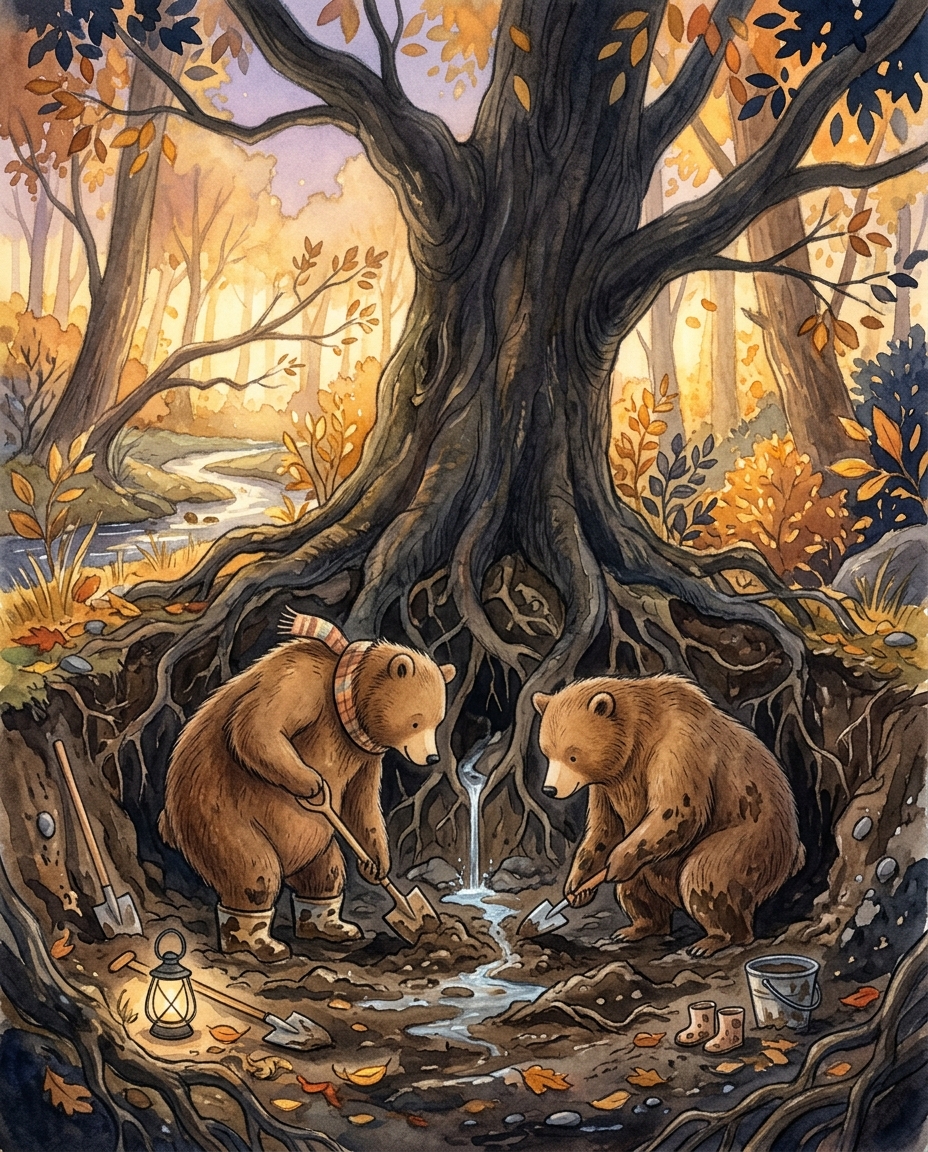
One of the roots — a great arching root that rose from the ground like the spine of a buried creature — was dry. Not just seasonally dry. Bone dry, the way a root only gets when it hasn't had water in a long time. He followed it underground, digging carefully along its length, until he found a small underground stream bed — the kind of seeping channel that feeds a single root system — that had no water in it at all.
He followed the stream bed further. It ran twenty yards north before ending at a pile of rocks and compacted earth: a collapse, probably from last winter's heavy ground freeze. The stream wasn't gone. It was blocked.
He could see the damp soil on the other side of the collapse. Water was pooling there, pressing against the blockage, unable to get through.
If he could shift the rocks — even some of them — the stream would run again.
He tried.
He pulled at the largest rock for twenty minutes, his claws scraping uselessly against its surface. He tried a different angle. He tried wedging a branch beneath it. The rock did not move. The collapse was deep and dense and heavy, and shifting it needed more than one bear's strength.
He sat in the dirt and breathed hard.
He was going to have to find Oswin.
He had been avoiding this conclusion for three days. He was not proud of that.
He climbed out of the excavation and looked around at the surrounding forest — and stopped.
Twenty yards to the west, he could see another excavation. Fresh-dug earth, a substantial hole, obviously begun with energy and continued with considerable determination over several days.
He walked over and looked down into it.
It was in entirely the wrong place — too far west, aimed at the wrong root system — but the work itself was extraordinary. Oswin had moved more earth in three days than Bram would have thought possible.
He had been wrong and he had been working very hard at being wrong, which somehow made Bram feel worse and better at the same time.
CHAPTER THREE: Together
It took Bram some time to find Oswin, who had moved away from the failed excavation and was now trying to redirect a surface runnel of rainwater toward the tree's base — an approach that would not work but showed he had been thinking about water, which meant they had arrived at the same understanding from different directions.
"You found the stream," Oswin said, before Bram could speak. Not a question.
"Yes."
"It's blocked."
"A collapse. I can't shift the rocks alone." Bram looked at his brother. "I should have told you what I was doing three days ago. I was..." He searched for the right word.
"Being you," said Oswin, without malice.
"Yes," said Bram. "I was being me. And you should have waited and looked at the evidence first. You were—"
"Being me," said Oswin.
"Yes."
They looked at each other for a moment — the slightly uncomfortable look of two people who have known each other long enough that apologies can be done efficiently — and then Oswin said, "Show me."
At the blockage, the difference was immediate. What Bram could not shift alone, two bears could move entirely differently. Oswin, who was stronger and less careful about precision, attacked the larger rocks with the force that had moved twenty yards of earth in three days. Bram, who was precise and methodical, worked on the smaller stones and gaps, identifying the load-bearing points, finding the order in which things needed to be moved.
It took most of an afternoon.
The first trickle of water came through a gap they had opened on the left side — cold and clear, threading through the dark soil. Then more. Then the blockage shifted as a whole and the stream began to run again, properly, following its old bed toward the root.
They climbed out of the excavation and stood together, covered in earth, watching the water flow.
By the next morning, the stream had fully re-established. The damp soil was spreading around the exposed root. Three days after that, the first new leaves appeared on the lower branches — small and green and unmistakably alive.
Old Nell emerged from her burrow and looked at the leaves and then at the two muddy bears standing beside the root.
"Well," she said.
"It'll take time," said Bram. "The root system will need weeks to fully recover."
"Months," said Oswin. "Probably through spring."
Bram glanced at him. "You've been reading."
"Pethwick's library," said Oswin. "He lent me four volumes. I've finished two."
Bram was quiet for a moment. "I didn't know you went there."
"You didn't ask," said Oswin.
This was true. Bram thought about how much of his brother he had assumed, over the years, without checking.
"The spring monitoring," he said. "I usually do it alone. Would you—"
"Yes," said Oswin.
"I keep detailed records," Bram said, in the tone of someone issuing a warning.
"I know," said Oswin. "You've kept them our whole lives. I've always known where to look when I needed to find something out." He paused. "I just never told you I used them."
Bram turned this over.
"That's actually," he said slowly, "a kind of compliment."
"It absolutely is," said Oswin.
They stood together in the autumn forest, the ironwood alive and recovering above them, its dark bark warm in the afternoon light, its roots drinking steadily from a stream that was running again.
Nell went back inside. She had seen this before, as she had told herself she would. Always two brothers. Always the same argument. Always, eventually, the same outcome.
Some things, she reflected, taking a long sip of her tea, were very reliably themselves.
Hearth Yarns
Hear it narrated — with watercolour art
Get the app to hear this story read aloud, or generate your own in a voice you record.