The Cartographer's Mistake
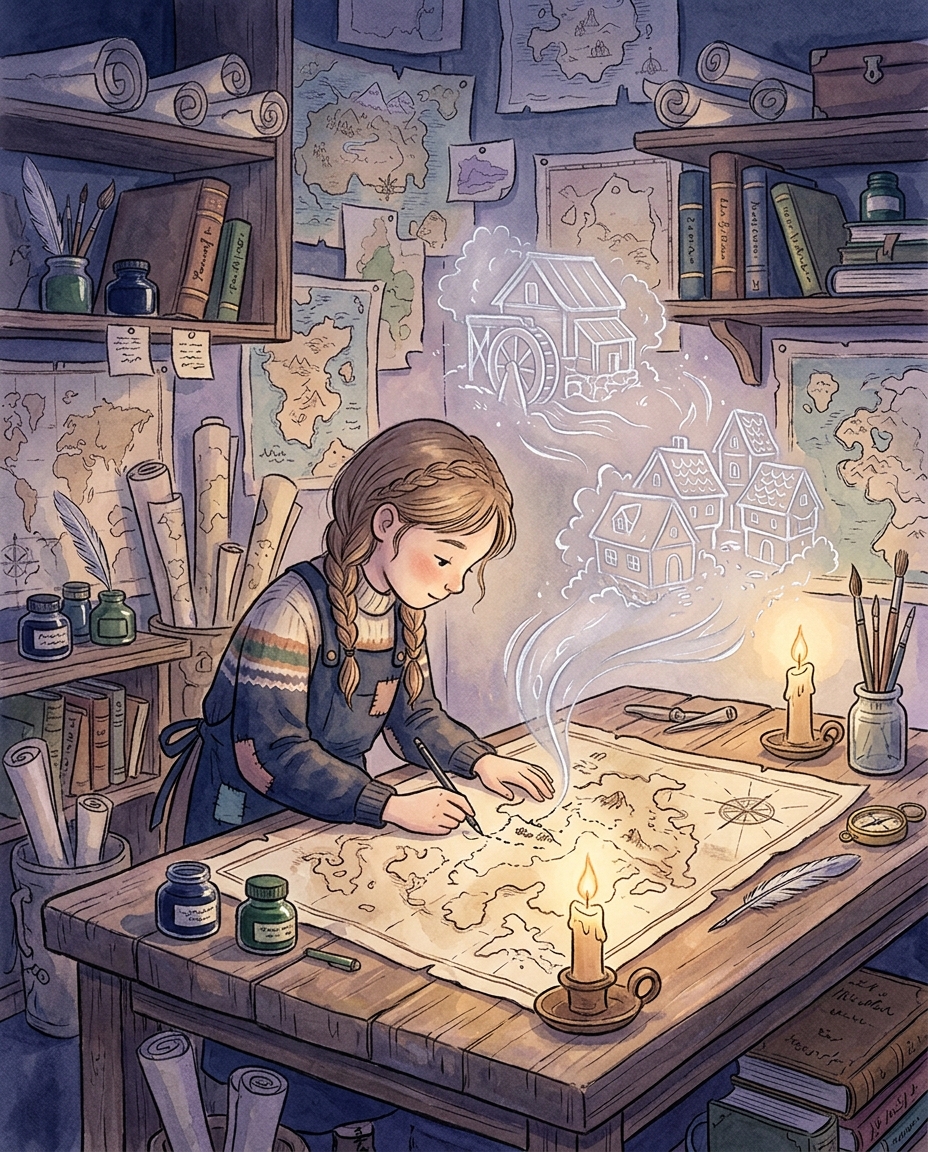
A mapmaker's apprentice named Willa discovers that the maps her master draws are not just records of places — they shape them. When she finds a half-finished map of a ruined village, she must decide what to add, knowing that what she draws will become real.
STORY: Willa had been Master Aldren's apprentice for two years before she understood what the maps actually did.
She had thought, in the beginning, that he was simply a very accurate cartographer. He was certainly precise — he measured everything twice, drew contours with a fine-tipped pen, insisted that every bridge and well and tree line be placed exactly where it stood. His maps were beautiful. Travellers relied on them. Merchants commissioned them. They were known to be the truest maps of the region.
It was only when she noticed the orchard that she began to understand.
Master Aldren had mapped the valley of Norwick the previous spring, and on the eastern side of the village he had drawn a young orchard in careful dotted ink — the symbol he used for new plantings, not yet established. There had been no orchard there when she'd walked that road. She'd noticed the field as they surveyed, bare and unplanted.
But when the merchant from Norwick came in autumn to buy a copy of the map, he mentioned, as an aside, that the new orchard on the eastern slope had taken well this year.
Willa did not say anything. She found a reason to go back to Norwick before winter. The orchard was there. Twelve young apple trees, in two careful rows.
She thought about this for a long time before she asked.
Master Aldren listened to her question and was quiet for a moment and then said: "The map makes what is true more true. It does not create from nothing. But it can — if the drawing is done with sufficient care and the draughtsman knows what is wanted — bring something forward that would otherwise not be found."
"The farmer didn't plant those trees because of the map," said Willa.
"No," said Aldren. "He planted them because it had always been good land for apples, and the map confirmed it."
It was not a complete explanation. Willa had the feeling it was as complete as he intended to give.
Three months later, Aldren was travelling and she was alone in the workroom when she found the half-finished map.
It was a survey of the village of Corrath, which had been abandoned twenty years before following a flood that had made the river jump its banks. The village was empty now: stone foundations, no roofs, a silted-up millpond, the mill itself in three-quarter ruin.
Aldren had mapped the foundations accurately and the ruined mill and the silted pond. Then he had left it unfinished.
On the blank portion of the map — the eastern quarter, where the village had ended — he had drawn nothing.
Willa looked at the map for a long time. She looked at the ruined mill. She looked at the silted pond.
She picked up the fine-tipped pen.
She drew the mill as it would look repaired: the wheel replaced, the roof sound, the walls repointed. She drew the pond clear, the sluice open. In the blank eastern quarter she drew a small row of houses — not many, four or five — set back from the river, in better positions than the old ones had been. She drew a well. She drew a garden.
She drew carefully. She drew with sufficient care.
Then she put the pen down and looked at what she had done.
She felt two things at once: a kind of quiet satisfaction that came from good work, and something less comfortable — a question about what she had decided, and for whom, and whether the people who might find their way to Corrath would want what she had put there.
She did not know how to answer that yet. She wrote a note to Aldren, telling him what she had done and asking for his guidance, and placed it on top of the map.
Then she went to bed and thought about it for a long time before she slept.
Hearth Yarns
Hear it narrated — with watercolour art
Get the app to hear this story read aloud, or generate your own in a voice you record.