The Millstone and the Village
The mill had been broken since April, and Bea's uncle had been dead since June, and by the time the solicitor had finished reading the will, Bea understood that she had inherited both of these facts simultaneously.
The mill sat at the northern edge of the village of Hawthorn, on the bank of the River Stell. It was a stone building, honest and old, with a wheel that had not turned in three months due to a split in the main axle and a crack in the sluice gate that no one had had the money to repair. The outstanding debts owed to the mill — the grain her uncle had agreed to process for various farmers before the breakdown — were listed in a small ledger in neat handwriting. The debts the mill owed to suppliers were listed in another, in less neat handwriting.
Bea was practical. She was sixteen, which is old enough to understand that a broken mill with debts is not the same as a working mill, and that the sensible thing to do was to sell it to whoever wanted it and use the money to clear what was owed.
She went to the mill the next morning to take stock.
The miller's daughter, Roz — who had worked as her uncle's assistant for two years and was now technically employed by no one — met her at the door with the ledger and a cup of tea and a calm, business-like manner that Bea found immediately easier to deal with than sympathy.
"The axle is the main thing," said Roz. "Old Prentis the blacksmith says it's fixable. Two days' work, maybe three."
"That's not cheap," said Bea.
"No. But the sluice gate is easier than it looks. My father says he can do it in a day if the materials are right."
Bea looked at her. "Your father is a carpenter?"
"He builds boats mostly," said Roz. "But the principle is the same."
Bea drank her tea and made a list of what was needed and added up the likely cost and concluded, as she had expected, that it was beyond what she could manage without selling something first.
She went home and wrote a letter to the solicitor.
The next morning, there was a knock at her door. It was Prentis the blacksmith.
"I'll do the axle at cost," he said. "Materials only. My labour is a gift."
Bea stared at him.
"Your uncle ground my family's grain for thirty years," he said. "Same terms, whatever we had. When times were hard, he carried the account. I'm calling that in now, except I'm calling it in on his behalf."
He left before she could say much.
That afternoon, Roz's father appeared at the mill with two apprentices and a cartload of timber and began work on the sluice gate. He waved away Bea's question about payment with a hand gesture that indicated the topic was closed.
Over the following week, the village came in pieces. The farrier's wife brought mortar and re-pointed the east wall. Two brothers from the flour merchant's family replaced the worn millstones on their own time. An elderly woman who had been a mill hand in her youth came and cleaned and oiled the gearing, talking the whole time about the proper way to do it, and refused absolutely to be thanked.
Bea spent the week keeping accounts and making tea and trying to understand what was happening.
On the eighth day, Roz put down a ledger and said: "They remember what it's like when the mill works. They grew up with it. They want it back."
"They didn't have to," said Bea.
"No," said Roz. "That's rather the point, isn't it."
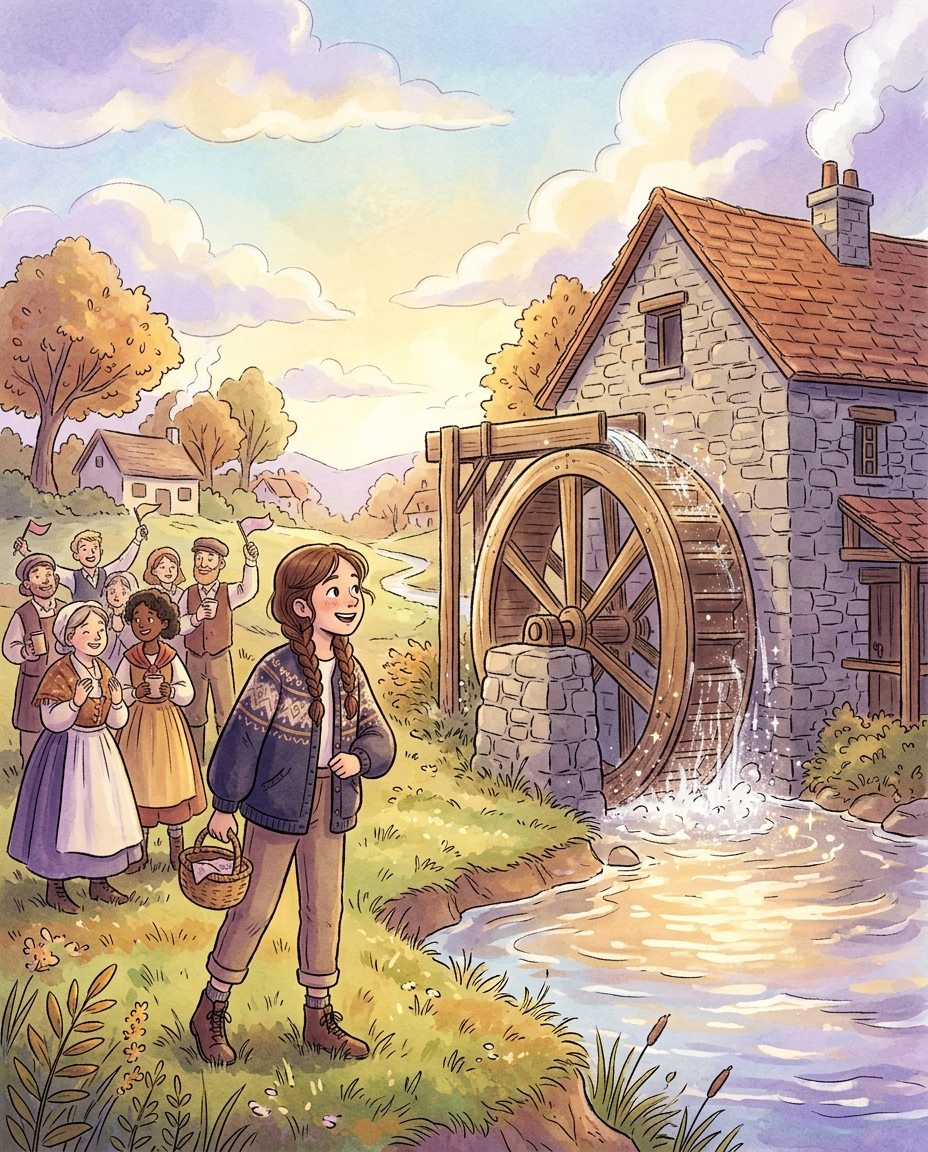
The wheel turned for the first time on a Tuesday afternoon, with Bea standing on the bank watching it. The water took it and it moved — slow at first, then finding its speed, the long creak of wood and water that Roz said she had missed without knowing how much.
Bea stood and watched for a long time.
She did not sell the mill. She wrote a new letter to the solicitor with different instructions, and she asked Roz to stay on, and she began to learn the trade from the beginning.
Hearth Yarns
Hear it narrated — with watercolour art
Get the app to hear this story read aloud, or generate your own in a voice you record.